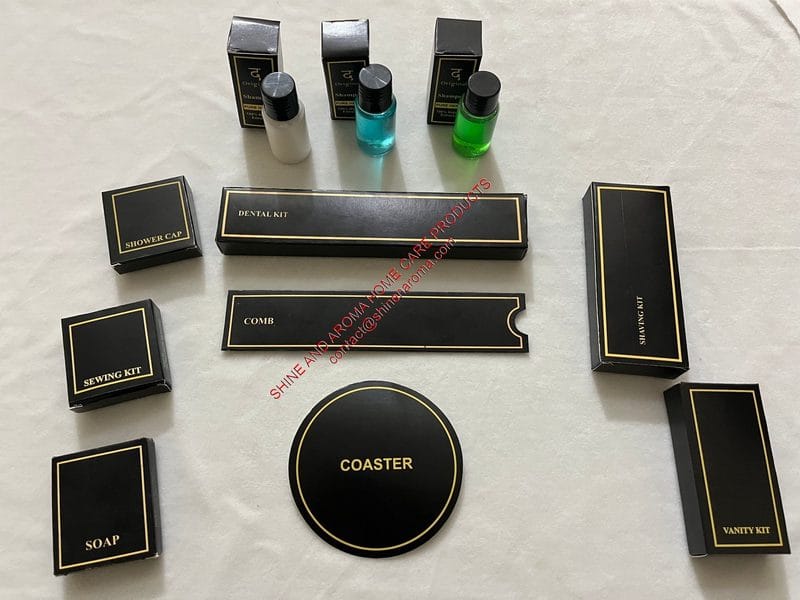
The vanity kit is the part of the hotel amenity programme where procurement spreadsheets quietly leak money. Most chains carry three or four vanity SKUs (dental, shaving, sewing, comb) that each look like a tiny line item — ₹8-15 per kit — and together quietly add ₹40-55 to the per-room amenity bill. Spread across a 200-room property at 65% occupancy, that is roughly ₹19 lakh a year on items the guest barely touches.
This is a useful place to think hard about which vanity kits actually earn their slot, and which are there because the spec template said so.
The four kits, ranked by guest pickup rate
Across housekeeping reports we have seen from properties auditing their amenity programmes, the actual guest-pickup rate for vanity kits varies enormously. Rough ranges:
| Kit | Guest pickup rate | Decision |
|---|---|---|
| Dental kit (toothbrush + 5 g paste) | 40-65% | Keep — high pickup, high gratitude |
| Shaving kit (razor + 5 g shaving cream) | 15-25% | Keep, but consider on-request only |
| Comb | 20-30% | Keep — cheap, useful, low waste |
| Sewing kit | 3-7% | Switch to on-request — most are discarded unopened |
Properties that move their two lowest-pickup vanity items to on-request typically save ₹14-22 per occupied room without measurable guest satisfaction impact. The maths is straightforward: a 65%-occupancy 200-room property using the spec above saves about ₹6.5-10 lakh per year by switching sewing and shaving to on-request.
Why "complete" vanity kits are over-specified
Most vanity-kit briefs we receive are inherited from a template written when the chain first opened a flagship in the early 2000s. The template spec'd everything because the flagship needed a "no guest leaves without it" experience. That spec then got copied to the entire portfolio, including business hotels in the same chain where a sewing kit is genuinely surplus.
The fix is not to remove vanity kits — it is to tier them. A flagship gets the full set in-room. A business hotel keeps dental + comb in-room and moves shaving, sewing and dental floss to a "request from housekeeping" basket at reception. The amenity programme stays consistent in branding; the line-item spend drops 30-40%.
The packaging trap
Vanity kits have a packaging-vs-contents ratio that surprises new buyers. A well-presented dental kit (small toothbrush + 5 g paste in a folded butter-paper sleeve with embossed branding) costs roughly ₹11 — of which the toothbrush and paste are about ₹4.5, and the sleeve, sticker and assembly are ₹6.5. The presentation is more than the product.
This is correct. It is also where buyers can save: a generic plain-paper envelope brings the kit cost down to ₹6.5 with no functional change. The trade-off is a less photographable amenity at check-in. For business properties where guests do not photograph their amenity, the saving is free money. For honeymoon resorts where they do, the envelope is part of the product.
A note on quality of the small items
Razors and toothbrushes are where a quality lapse hurts most because the guest interacts with them directly and physically. A poorly-made razor cuts; a poorly-made toothbrush splays. Both leave a memorable bad impression that the rest of the amenity programme cannot rescue.
The minimum specs we recommend:
- Toothbrush: nylon bristles 8.5-9.5 mm, polished tips, soft grade, anti-slip handle. Cost difference vs the cheapest version: about ₹1.50 per unit.
- Razor: twin-blade with lubricating strip; single-blade is acceptable only for budget tier. Cost difference: about ₹2.50.
- Toothpaste: BIS-marked Indian brand or our private-label tube; never an unbranded paste. The label matters because guests inspect.
- Dental floss: optional. Use only if your guests are in a market where it is expected (US, UK, GCC); not in domestic-Indian properties.
What we ship
Our vanity kit range covers the four standard kits plus a "spa add-on" (loofah, bath salts sachet, eye mask) for resort use. Standard MOQ is 30,000 kits per SKU; private-label printing on the sleeve adds a 4-week setup but no per-unit cost above the print plate amortisation.
A practical sourcing change
If you are auditing your vanity programme, the single change that returns the most savings for the least disruption is moving sewing to on-request. It is the lowest-pickup vanity, the easiest to move, and the saving (about ₹3-5 per occupied room) compounds across the portfolio. Try it on five properties for a quarter; track the on-request count from housekeeping; expand if the count is below 8% of occupancy (it will be).
Get in touch with your current vanity programme spec. We will quote it as-is and as-rationalised, so you can see the tier saving before committing.
Sources & Citations
- 42% of hotel guests take unused amenity items homeSource: Hotel Management Magazine – Guest Amenity Survey 2023 - View Source
- India's personal care contract manufacturing sector has over 2,000 registered facilitiesSource: Indian Beauty & Hygiene Association (IBHA) - View Source
Ready to Start Your Project?
Partner with Shine And Aroma Home Care for expert contract manufacturing services. Our team is ready to bring your product vision to life with quality and precision.
