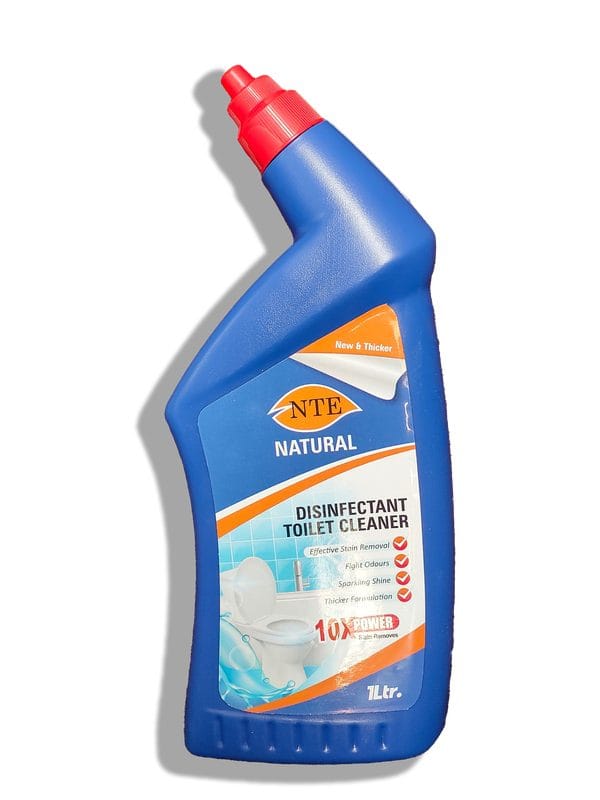
Pick up a bottle of toilet cleaner from a supermarket shelf and a 5-litre jerry can from a hotel housekeeping trolley side by side, and the chemistry on the back label looks similar. Acidic system, perfumed, blue-coloured. The two products are not the same. The supermarket bottle is engineered for a homemaker who cleans one toilet twice a week. The jerry can is engineered for a housekeeping attendant who cleans 90 toilets a day, against an SLA, in a building where a single missed urinal will be photographed by a guest.
The differences matter — for procurement, for safety, and for the per-toilet cost.
Where the chemistry actually diverges
Consumer toilet cleaner is mostly hydrochloric acid (8-12%) thickened with a low-cost polymer, fragranced loud, and packaged in a 500 ml angled-neck bottle. The dose is one squeeze, neat, on light daily soil.
Industrial-grade toilet cleaner spec'd for commercial facilities looks like this:
| Spec line | Consumer | Industrial |
|---|---|---|
| Active acid | HCl 8-12% (cheaper, harsher) | HCl 15-22% or sulfamic 8-12% (controlled, lower fume) |
| Thickener | Low-cost polymer; thins out by month 6 | High-MW polymer; viscosity stable for 24 months |
| Surfactant | Minimal; just enough to wet the porcelain | Cationic + non-ionic blend; clings under the rim |
| Corrosion inhibitor | Usually none | Required (protects chrome, brass, lead pipes) |
| Fragrance | Loud (masks odour for the homemaker) | Strong but balanced (must not register as 'chemical' to a guest 30 seconds later) |
| Pack | 500 ml retail bottle | 1 L angled-neck for trolley; 5 L, 25 L, 200 L for central store |
The corrosion inhibitor is the line most home buyers do not realise exists. Repeat use of a consumer-grade HCl product on chrome flush handles produces visible pitting within four to six months. Hotel housekeeping using consumer-grade in a luxury bathroom means chrome replacement on a 24-month cycle instead of a 6-year cycle.
The actual cost comparison
Per litre at retail, consumer toilet cleaner is roughly ₹120-180. Industrial concentrate at hotel-volume pricing is ₹85-140 per litre. The industrial product is cheaper per litre AND lasts longer per dose because the higher active and the cling-to-porcelain surfactant blend means less product per toilet. A typical hotel toilet uses about 12-15 ml of industrial product per clean; a consumer product would need 25-30 ml for the same result.
For a 200-room property cleaning bathrooms twice daily at 65% occupancy, that is roughly 28 litres of product per month. Switching from consumer-grade to a properly spec'd industrial concentrate saves about ₹4,500-6,000/month at this scale plus avoids the chrome-pitting capex.
Where industrial cleaners go wrong in the field
Three issues account for almost every industrial-toilet-cleaner complaint we receive from buyers:
Wrong dilution training. The industrial concentrate is sometimes spec'd at 1:5 for heavy soil, 1:10 for daily. New housekeeping staff use it neat thinking stronger is better. Result: chrome pitting, complaints about smell, and 3x the consumption. The fix is the dilution chart on the wall of the central store, in English and the local language. We ship the bilingual chart with every consignment.
Stored in the wrong container. Industrial concentrate at 18% HCl will dissolve a galvanised drum, react with aluminium fittings, and embrittle some plastics. The correct container is HDPE (which is what we ship in). The wrong container is anything the property happened to have lying around. Train the central-store staff: never decant.
Mixed with bleach. This is the failure that hospitalises housekeeping staff. Acidic toilet cleaner + chlorine bleach = chlorine gas. Every hotel housekeeping has a bleach product nearby (laundry, kitchen, sometimes a separate disinfectant). The training has to be explicit, not assumed. Our SDS and bilingual handling chart spell this out in red type.
What we ship
Our industrial toilet cleaner is an HCl 18%, high-MW thickened, cationic-blend formulation in 1 L angled-neck (for trolleys), 5 L jerry can, 25 L carboy and 200 L drum. Sulfamic-acid variant available for properties with sensitive plumbing or noise-sensitive guests (lower fume profile, slightly higher cost). Cost-in-use lands roughly 30-40% below comparable branded industrial concentrates from multinationals.
For a related comparison piece, see UCLIPSE U6 vs Diversey Taski R6 for the housekeeping-cart angle.
A practical evaluation
Order a 1 L trial bottle. Run it on the worst-soiled urinal under-rim section in your facility — neat, dwell five minutes, brush, flush. Inspect the next morning under direct light. If the scale is gone and the chrome is unmarked, the product is right for you. Get in touch with your property type and monthly toilet-cleaner consumption and we will quote and ship the trial within a week.
Sources & Citations
- The global industrial cleaning chemicals market is expected to reach $74.3 billion by 2027Source: MarketsandMarkets – Industrial Cleaning Chemicals Market Report - View Source
- India's chemical manufacturing sector employs over 2 million workers and contributes 7% to the national GDPSource: Indian Chemical Council – Industry Overview - View Source
Ready to Start Your Project?
Partner with Shine And Aroma Home Care for expert contract manufacturing services. Our team is ready to bring your product vision to life with quality and precision.
