The single most-rejected glass cleaner in hotel housekeeping audits is one the buyer was perfectly happy with at the demo. The demo was conducted at 11 AM, in the office of a procurement manager, on a north-facing window. The audit failure happens at 3 PM, on the south-facing porte-cochère pane, in low-angle direct sunlight. Same product. Different lighting. Different result.
Streak-free glass is, fundamentally, a question about under what light the result is being judged. Once you understand that, the chemistry choices follow.
The two failure modes
A glass cleaner can fail in two ways, and they have completely different causes.
The first is streak. A visible smear left by surfactant or solvent that did not fully evaporate. This is a chemistry problem — the formulation has too much surfactant load, or the wrong solvent volatility, or both. Streaks are visible in raking light (low-angle) and almost invisible in diffuse light. A product that is fine in your office at 11 AM will streak in the lobby at 3 PM.
The second is bloom. A faint cloudy haze, often near the edges of the pane, caused by water minerals (calcium, silica) drying onto the glass before the surfactant could lift them. This is a hard-water problem — the cleaner's chelant is insufficient for the water it was diluted in. Bloom is visible in transmitted light (you see it when looking through the pane towards a bright background) and almost invisible in reflected light.
A buyer who only does the demo in one lighting condition catches one failure mode at most.
What an actual professional glass cleaner contains
The specification looks like this:
- Glycol ether solvent (typically butyl glycol or ethylene glycol mono-butyl ether) at 4-8% — fast evaporation, good soil dissolution
- Non-ionic surfactant at low load (0.3-0.6%) — too much causes streak; too little fails on heavy fingerprints
- Chelant (EDTA or GLDA) at 0.1-0.3% — handles hard-water minerals so they don't dry as bloom
- Optional: ammonia at 0.5-1.5% — lifts grease and accelerates dry; not used in formulations meant for use near electronic displays
- Carrier: deionised water, not tap water — the manufacturing water itself can cause bloom
Most "premium" retail glass cleaners cut corners on the chelant and skip the deionised water. They work fine on softened or RO water; they bloom on Indian municipal supply.
The two-variant question
Most properties need two glass cleaner SKUs, not one. A standard variant for general lobby, lift, partition glass; and an ammonia-free variant for use near AV equipment, digital signage, banquet projection screens, and showroom anti-reflective panel surfaces. Ammonia degrades anti-reflective and oleophobic coatings over time — not catastrophically, but visibly within 12-18 months on a daily-clean schedule.
A property with no AV equipment can run the standard variant only. A property with banquet AV, digital concierge walls or showroom screens needs both.
The afternoon-sun streak test
The protocol I recommend to every procurement team evaluating a new glass cleaner:
- Pick a south-facing or west-facing pane in your actual property — not the supplier's office
- Clean half the pane with the candidate cleaner, half with your current product
- Wait until 3-4 PM on a clear day
- Stand at a 30° angle to the pane and inspect both halves under raking sunlight
- Then walk to the other side of the pane and look back through it at a bright source
The first inspection catches streak. The second catches bloom. A cleaner that passes both is genuinely streak-free; a cleaner that passes only one is conditionally streak-free.
For deeper context on the housekeeping-cart angle, see UCLIPSE U3 vs Diversey Taski R3 which describes the same test on a Gurgaon porte-cochère.
Cost-in-use
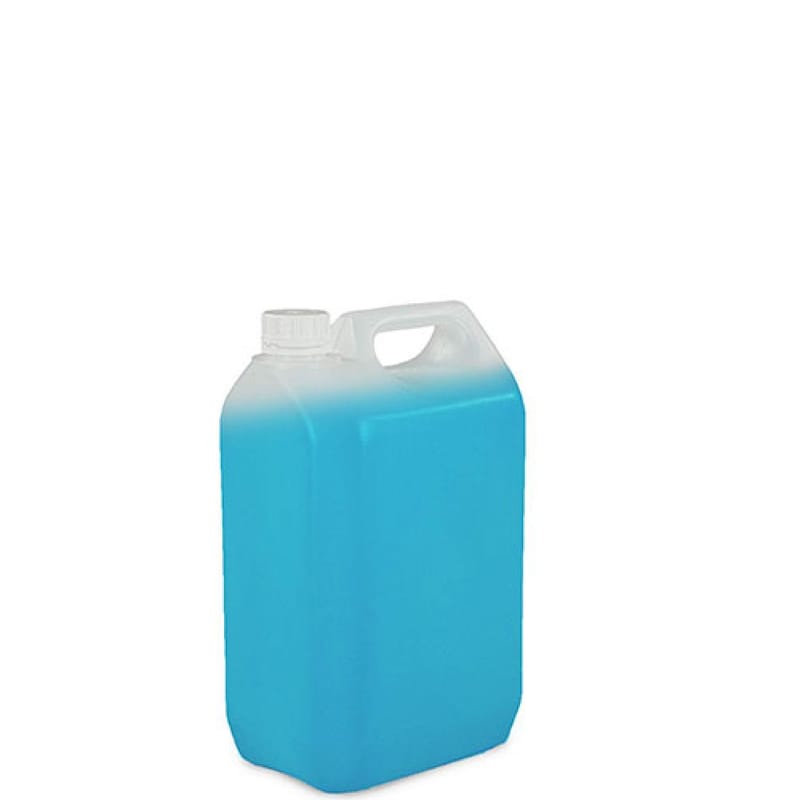
A professional glass cleaner concentrate (1:10 to 1:20 dilution) lands at ₹140-200 per litre at hotel volumes. A 5L jerry diluted at 1:10 yields 55 L of working solution — enough for roughly 11,000-14,000 sq ft of glass at a single-pass spray-and-wipe rate. Per-square-foot cost works out to about 8-12 paisa.
For an OEM/private-label distributor, the same formulation in a 500 ml retail trigger packs at a premium of 40-60% over discount-shelf brands and competes well against premium retail glass cleaners.
What we ship
Our commercial glass cleaner ships in 500 ml ready-to-use trigger, 1 L flip-cap, 5 L jerry, 25 L carboy and 200 L drum. Standard and ammonia-free variants available; the ammonia-free variant adds about 8-12% per litre. We support OEM private-label runs from 5,000 retail units; the formulation, fragrance and label are fully customisable.
Talking to us
Send us your property type (hotel / mall / airport / showroom / corporate office) and rough daily glass area. We will quote, ship a sample, and recommend the variant — and provide the bilingual operator chart that ships with every consignment.
Sources & Citations
- The global glass cleaner market reached $4.2 billion in 2023 with institutional use accounting for 45% of consumptionSource: Transparency Market Research – Glass Cleaner Market Report - View Source
- Glass usage in commercial building envelopes has increased by over 40% since 2000, driven by energy efficiency regulations and architectural trendsSource: Council on Tall Buildings and Urban Habitat – Facade Trends Study - View Source
Ready to Start Your Project?
Partner with Shine And Aroma Home Care for expert contract manufacturing services. Our team is ready to bring your product vision to life with quality and precision.
