A bathroom cleaner that satisfies an Indian hotel housekeeping captain and a bathroom cleaner that passes an EU hygiene audit are not necessarily the same product. The captain cares about visible result and smell. The audit cares about log-reduction kill rates against named pathogens, written test reports, and the question "show me the EN-1276 dossier".
This post is for the property that is moving from domestic-Indian standards to international audit-grade hospitality, or for the brand sourcing a bathroom cleaner concentrate for export to a market that requires the dossier.
The two standards that matter
For bathroom cleaners shipped into hospitality markets that audit, two European norms cover most requirements:
EN 1276 — the bactericidal activity test. The cleaner must demonstrate at least 5-log reduction (99.999%) against a panel of test organisms (typically *Pseudomonas aeruginosa*, *Escherichia coli*, *Staphylococcus aureus*, *Enterococcus hirae*) within five minutes of contact, in clean and dirty conditions, at the manufacturer's recommended dilution.
EN 13697 — the surface bactericidal activity test. Same organisms, but tested on a stainless-steel carrier surface to simulate actual cleaning conditions. The required log-reduction varies by the claim being made, with hospital-grade typically requiring 4-log within five minutes.
For US markets, the equivalent EPA registration tests use *Salmonella enterica* and *Staphylococcus aureus* with similar log-reduction requirements. For GCC markets, audits typically reference the EU norms directly.
What this means for formulation
A cleaner that passes EN 1276 cannot rely on detergent action alone. It needs a true biocidal active. The common choices for an acidic bathroom cleaner are:
| Active | Kill profile | Use notes |
|---|---|---|
| Quaternary ammonium (BAC, didecyldimethyl) | Broad-spectrum bactericide; weaker against viruses and spores | Often combined with acid; cost-effective |
| Hydrogen peroxide (3-7%) | Bactericidal, virucidal, sporicidal at higher concentration | Single-use solution; degrades in storage |
| Lactic acid (3-5%) | Bactericidal; food-grade safety profile | Used in high-end and 'green' formulations; costs 2-3x |
| Sodium hypochlorite (bleach, 1-2%) | Strong virucide and sporicide | Cannot mix with acidic systems; separate SKU |
Most domestic Indian bathroom cleaners use neither. They rely on acid + surfactant for visible cleaning and do not make biocidal claims. That is fine for everyday housekeeping; it does not pass an audit.
What the audit actually asks for
A typical international hotel hygiene audit (Cristal, ALLSafe, Diversey-aligned, ISSA framework) asks the housekeeping director four questions about each cleaning chemical:
- Where is the SDS / MSDS, in English, current edition?
- Where is the EN test report or equivalent third-party test data?
- Where is the dilution chart, posted at the central store?
- Where is the operator handling chart, in the local language of the housekeeping team?
Properties fail audits not because they use the wrong product, but because they cannot produce these four documents on demand. The product is the easy part. The documentation infrastructure is the part that takes effort.
Two products, not one
Most international-grade hospitality programmes carry two bathroom cleaners on the trolley: a daily-mild for turn-down and a periodic-heavy for deep clean. The daily-mild is biocidal-claimed at the dilution used for daily wipe-down; the periodic-heavy is acidic-strong for periodic limescale and rust. This two-tier system also makes audit compliance easier — the daily product is the one on the trolley, and it is the one with the visible documentation.
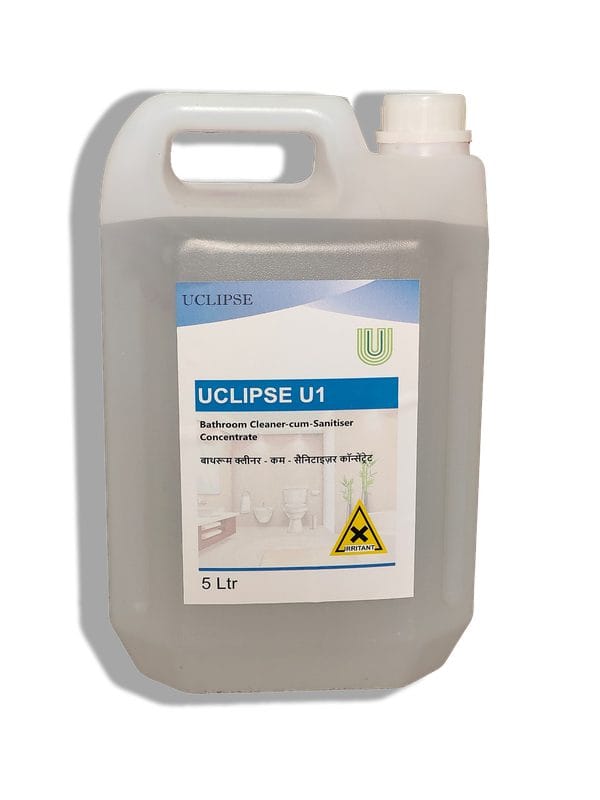
For deeper context on the daily-mild slot, UCLIPSE U9 vs Diversey Taski R9 describes the chemistry choice. For the periodic-heavy slot, UCLIPSE U1 vs Diversey Taski R1 covers the deep-clean side.
What we ship for international-audit properties
Our bathroom cleaner concentrate ships in two configurations: a quat-acidic combination that holds EN 1276 at 1:20 dilution, and a hydrogen-peroxide-based variant for properties that need the broader virucidal profile. Both ship with the EN test report, a current SDS, the bilingual dilution chart and the bilingual operator chart. The audit dossier is part of the consignment, not a separate request.
The quat-acidic variant lands at ₹85-130 per litre at hotel volumes; the peroxide variant at ₹160-220 (the peroxide chemistry is more expensive and has shorter shelf life, so it is priced and packed differently — typically smaller pack sizes, faster turnover).
Practical advice for property managers
If you are running a property that is about to be audited and the current bathroom cleaner has no test dossier, you have two options. Switch to a product with a test dossier (about a six-week project including operator training); or commission a third-party EN test on your existing product (about ₹80,000-1,40,000 and 4-6 weeks at an accredited Indian lab — most domestic products fail). The first option is usually cheaper and faster.
Get in touch with your audit framework (or "no audit yet, but planning one"), property type and number of bathrooms. We will quote, send the documentation pack alongside the sample, and connect you with a hospitality-trained applications consultant if your team needs the SOP rewrite as well.
Sources & Citations
- 76% of hotel guests cite bathroom cleanliness as the primary factor in repeat booking decisionsSource: J.D. Power 2024 North America Hotel Guest Satisfaction Index Study - View Source
- The global institutional cleaning chemicals market is projected to reach $55.3 billion by 2027, with hospitality accounting for 28% of demandSource: Grand View Research – Institutional Cleaning Chemicals Market Report - View Source
Ready to Start Your Project?
Partner with Shine And Aroma Home Care for expert contract manufacturing services. Our team is ready to bring your product vision to life with quality and precision.
