Hotel and hospital procurement teams almost always select a floor cleaner by the surface — vitrified, marble, epoxy, anti-static vinyl. That is the wrong starting question. The first question that should drive the spec is: do you mop by hand, or do you run an auto-scrubber? Because that single answer eliminates roughly two-thirds of the formulations on the market.
This post is for the procurement manager who has been mis-sold a "premium multipurpose cleaner" that froths the auto-scrubber's recovery tank and trips the float switch every fifteen minutes.
The foam problem, explained
A hand-mopping cleaner is allowed — even expected — to foam. Foam looks like cleaning. The mopper sees suds, believes the floor is being cleaned, and is happy.
An auto-scrubber cleaner cannot foam. The scrubber sucks up the dirty solution into a recovery tank, and any foam in that tank does two things: it triggers the float-switch shutoff (which stops the machine) and it eventually overflows out of the recovery system into the motor, which is a warranty-voiding repair.
A consumer or "premium hand-mopping" multipurpose cleaner has a foaming index of 200-400 ml. An auto-scrubber-rated cleaner has a foaming index below 50 ml. There is no overlap. Buying a consumer-grade multipurpose for an auto-scrubber programme guarantees a service call within the first month.
What an auto-scrubber-rated cleaner actually contains
The chemistry difference is in the surfactant choice and the de-foaming additive:
- Non-ionic surfactants (alcohol ethoxylates) at controlled HLB; not anionic LAS
- A silicone-based de-foamer in 0.05-0.15% load
- Neutral pH (6.8-7.4) — most multi-surface scrubber routines cannot risk acidic or alkaline drift
- A polymer wetting agent that keeps the solution sheeting on the floor for the brush-pass to lift soil
This formulation is more expensive per litre than a consumer multipurpose. It also lasts longer per unit area cleaned because the dilution is 1:80 to 1:200 (versus 1:30 to 1:50 for hand-mopping).
Cost-in-use: hand-mop vs auto-scrubber
Take a 30,000 sq ft daily-clean area as the comparison.
| Method | Concentrate per day | Concentrate cost/day @ ₹150/L | Labour |
|---|---|---|---|
| Hand-mop, consumer multipurpose @ 1:50 | ~6 L | ~₹900 | 4-5 hours, two staff |
| Hand-mop, professional multipurpose @ 1:80 | ~3.7 L | ~₹560 | 4-5 hours, two staff |
| Auto-scrubber, professional low-foam @ 1:120 | ~2.5 L | ~₹375 | 1 hour, one staff |
The auto-scrubber wins on every line — chemical, labour, time. The capex on the scrubber (₹2-4 lakh for a walk-behind) typically pays back in 14-22 months at this scale. Yet most properties under 50,000 sq ft floor-area still hand-mop because nobody ran the maths.
Surface compatibility — the secondary question
Once the foam profile is right, the surface question becomes secondary. A neutral-pH, low-foam professional multipurpose is safe on:
- Vitrified tile, ceramic tile, glazed porcelain — yes
- Sealed marble, sealed granite — yes
- Wood-laminate (with the manufacturer's recommendation; some don't allow wet mopping at all) — yes if sealed
- Epoxy floor, sealed concrete — yes
- Anti-static vinyl (computer rooms, hospital procedure rooms) — yes
- Unsealed natural stone — no, switch to a stone-specific cleaner
- Unsealed wood — no, wet cleaning generally disallowed
For mixed-surface properties, the universal answer is the neutral-pH professional multipurpose plus a stone-specific cleaner for any unsealed natural-stone areas. Two products cover 95% of typical hotel and hospital flooring.
What we ship
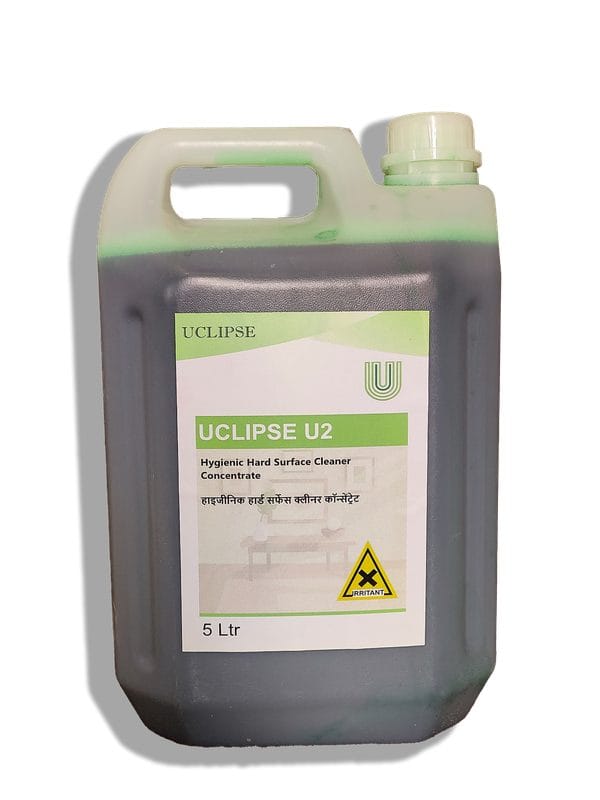
Our professional floor cleaner is the neutral-pH, low-foam multipurpose described above, in 1 L, 5 L, 25 L carboy and 200 L drum. For the hospitality crowd, the related comparison piece is UCLIPSE U2 vs Diversey Taski R2 which goes deeper into the supply economics.
A test you can run before buying
Take a 1-litre sample, mix at the spec'd dilution (e.g. 1:100), pour 200 ml into a transparent 500 ml bottle, and shake hard for 20 seconds. Watch the foam settle. A genuine auto-scrubber-rated cleaner has a foam head that collapses to less than 1 cm within 60 seconds. A consumer-grade product holds 4-6 cm of foam for several minutes. This is a 90-second test that costs nothing and answers the only question that matters for an auto-scrubber programme.
Get in touch with your daily-clean area, current cleaning method (hand-mop / auto-scrubber), and surface mix. We will quote, send a 1 L sample for the foam test, and follow up.
Sources & Citations
- Floor care represents nearly 30% of total commercial cleaning chemical spend globallySource: Freedonia Group – World Cleaning Products Market Study - View Source
- India's oleochemical production capacity has grown at 8% CAGR, making it a leading surfactant raw material hubSource: Chemical Weekly – Indian Oleochemicals Industry Report - View Source
Ready to Start Your Project?
Partner with Shine And Aroma Home Care for expert contract manufacturing services. Our team is ready to bring your product vision to life with quality and precision.
